
AI Isn’t Creating Franken-Jobs: Chaos Is a Choice — Human Skill Design Isn’t.
There’s a growing narrative that AI is forcing organizations to mash wildly different jobs together—three roles for the price of one—and call it “the future of work.”
That narrative is neat. It’s dramatic. And it’s largely wrong.
What the data actually shows is something more subtle—and more important:
AI is reshaping work through adjacent skill expansion, not by stitching together unrelated roles. And in the process, it’s putting a premium on human capabilities we’ve historically undervalued.
This isn’t about turning an HR partner into a data scientist, or a PMO lead into a machine-learning engineer. It’s about re-bundling tasks and capabilities that already sit near each other—and then elevating the human skills that machines can’t replicate.
From static jobs to dynamic skill bundles
Large-scale labour-market data shows that skills within jobs are changing far faster than jobs themselves. In many roles, roughly a third of required skills have shifted in just a few years. That’s not role elimination—it’s role evolution.
What’s happening underneath is task-level change:
- Routine, repeatable work is increasingly automated or AI-assisted.
- Judgment-heavy, ambiguous, and relational work expands.
- New responsibilities appear around oversight, validation, ethics, and design of AI-enabled workflows.
When organizations respond by simply “adding AI” as a bolt-on requirement, job architecture starts to crack. When they respond by re-anchoring roles around adjacent skills, work becomes more resilient and more human.
Adjacent skills, not skill chaos
The strongest signal in the data is that AI skills are spreading across functions—but they show up differently depending on context.
AI inside a finance role doesn’t look like AI inside marketing.
AI inside HR doesn’t look like AI inside a contact centre.
What does show up consistently is adjacency:
- Analytical reasoning paired with business judgment
- Digital fluency paired with stakeholder influence
- Process expertise paired with problem-solving and innovation
- Automation paired with accountability and risk awareness
This is not skill sprawl. It’s skill proximity.
The organizations getting this right aren’t creating mythical “purple squirrel” roles (little fun – a colleague used a new term the other day to describe these roles – I love it – a “rainbow unicorn that poops Skittles”). They’re asking better questions:
- Which tasks are changing?
- Which skills naturally sit next to those tasks?
- Which human capabilities become more important when AI enters the workflow?
The quiet rise of human skills
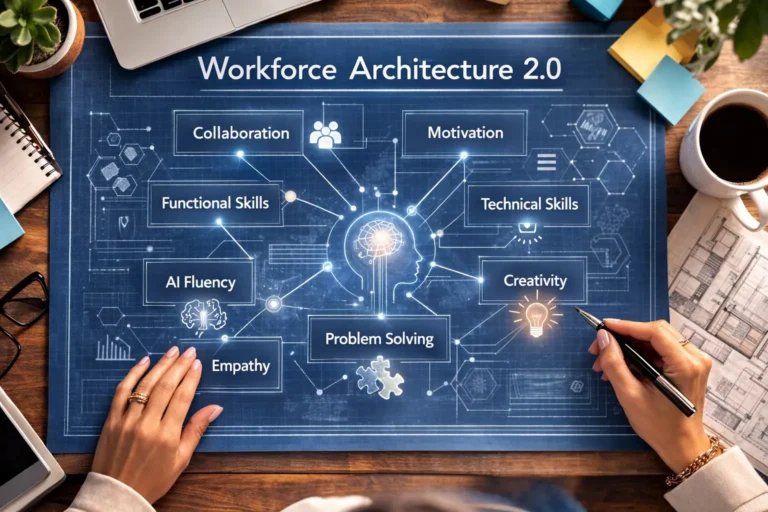
Here’s the part many people miss: as AI exposure increases, demand for human skills doesn’t fall—it rises. The World Economic Forum reinforces this shift: as AI accelerates, the fastest-growing skills are not purely technical, but deeply human — including creative thinking, resilience, flexibility, empathy, and leadership — because these capabilities become more valuable, not less, in AI-enabled work.
Across AI-exposed roles, employers are asking more for:
- Innovation and creative problem-solving
- Critical thinking and decision-making under uncertainty
- Emotional intelligence, empathy, and communication
- Leadership, coordination, and influence
Why? Because when machines handle more of the “how,” humans become responsible for the “why,” the “should we,” and the “what happens when this goes wrong.”
Empathy isn’t a soft add-on in an AI-enabled organization.
It’s a risk control.
It’s a trust mechanism.
It’s a performance multiplier.
Innovation isn’t a nice-to-have.
It’s how organizations adapt when the work itself keeps shifting.
What this means for job architecture and workforce design
If you’re redesigning roles right now, the evidence points to a few uncomfortable truths:
First, stop designing jobs as frozen snapshots. Roles need to be resilient to skill change, not defined by brittle task lists.
Second, resist the temptation to over-combine. When skills are too disparate, performance drops, burnout rises, and accountability blurs.
Third, invest deliberately in human capability. AI doesn’t reduce the need for people skills—it exposes the cost of not having them.
The future of work isn’t about asking people to become machines.
It’s about finally designing roles that let humans do what humans do best—while machines do what machines do faster.
And that’s not a downgrade.
That’s an upgrade.