
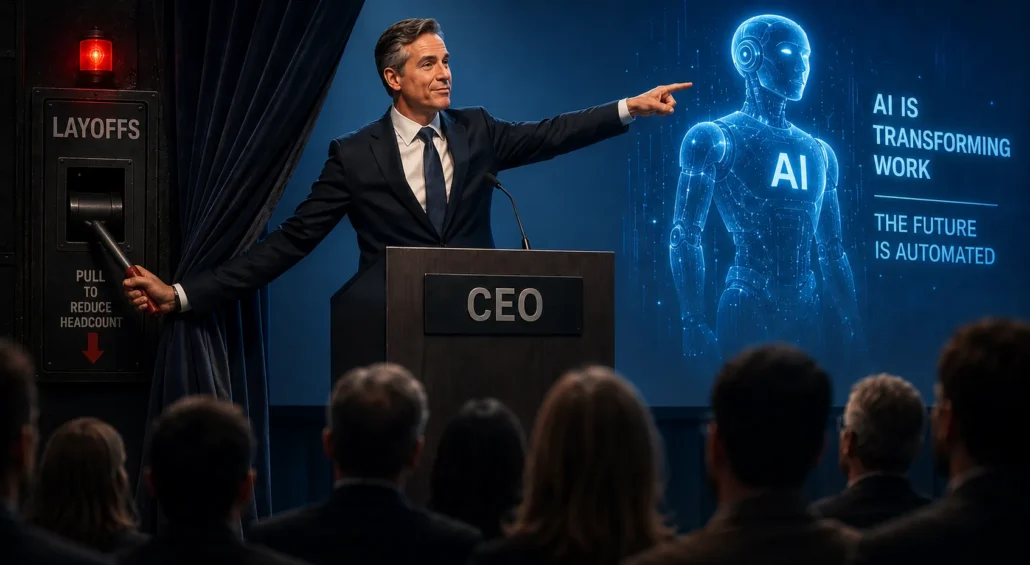
AI didn’t fire your colleague. Leadership did — and too many leaders would rather credit the algorithm than take accountability for the call.
There’s a new favourite line in the executive suite, and it goes something like this: “We’re reducing our workforce as we realize the efficiencies of artificial intelligence.” It sounds visionary. It sounds inevitable. It sounds like the future arrived on a Tuesday and, regrettably, your job was standing in the doorway. There’s just one problem. For most of the companies saying it, the AI in question is still a proof of concept that hasn’t scaled — these are not, by any honest definition, AI-native or fully AI-enabled organizations yet.
Let me be clear up front: I’m an enthusiastic supporter of AI. I use it every single day, personally and professionally, and I’m genuinely excited by what it can do — the build-out underway is the largest infrastructure bet in the history of the industry. But I also have a particular view of how this is playing out on the ground. I sit on the partner and consulting side of this work, advising companies through exactly this kind of transformation, which means I’ve had a window into hundreds of organizations — their strategy decks, their roadmaps, their boardroom ambitions, and the messy reality underneath. That breadth lets me say with some confidence that the gap between what leaders are saying about AI and what their organizations are actually doing with it is wide, and getting wider. What a CEO claims on an earnings call rarely matches what’s actually operating inside the company. And that gap is quietly becoming a trust problem — not about the AI agents and their hallucinations, but about the people holding the microphone.
The numbers don’t cooperate with the narrative
Let’s start with the data, because it’s unkind to the story. In 2025, the outplacement firm Challenger, Gray & Christmas counted roughly 54,000 announced layoffs in which companies cited AI as the reason. That sounds like a lot until you set it beside the total of more than 1.1 million job cuts: AI accounted for only about 4.5% of them. The overwhelming majority had decidedly less futuristic explanations — softening demand, cost discipline, and the long hangover from a hiring binge.
And what a binge it was. During the pandemic, with money essentially free, the tech giants hired like the boom would never end. Meta went from about 45,000 employees in 2019 to a peak of 86,482 in 2022 — nearly doubling. Amazon’s global workforce swelled from 798,000 at the end of 2019 to more than 1.6 million by the end of 2021, adding 310,000 people in a single year. Microsoft added 40,000 staff — a 22% jump — in the twelve months to June 2022. This was not a strategy so much as an appetite.
Then the Federal Reserve raised interest rates from near zero to about 5.5% in roughly fifteen months, the fastest tightening in decades, and the era of growth-at-any-cost ended abruptly. The layoffs that followed — about 165,000 tech roles in 2022, a record 263,000 in 2023, then declining every year since — line up almost perfectly with the cost of money, not the capability of algorithms. Here’s the detail that ought to end the debate: even after every round of cuts, each of these companies is still bigger than it was before the pandemic. Meta closed 2025 with roughly 79,000 employees — about 75% above its 2019 headcount. If AI were quietly hollowing out the workforce, someone forgot to tell the org chart.
And here’s the part that really complicates the “we need fewer people” story: the revenue tells the opposite tale. Meta’s annual revenue grew from about $70.7 billion in 2019 to over $200 billion in 2025 — it nearly tripled while headcount rose only around 75%. Each of the four giants posted double-digit revenue growth in 2025, with AI-linked cloud businesses among the fastest-growing lines. In other words, these companies are generating dramatically more revenue per employee than they did pre-pandemic.
Now, I’ll give the technology its due here. That decoupling — revenue rising far faster than headcount — is exactly what you’d expect if AI and automation are quietly making existing teams more productive, and I suspect they are. Growth no longer requires hiring at a 1:1 ratio, and that is a genuine, AI-assisted shift worth celebrating. But notice what that argument actually supports: hiring less in the future, not slashing the workforce you have today. Productivity gains explain why you might add fewer people next year. They do not explain why you’re cutting the people who built a business that nearly tripled its revenue. Those are different decisions, and only one of them is honestly about AI.
The leaders are doing my job for me
Normally, picking apart a corporate narrative takes some work. This time, the executives have generously done it themselves — sometimes within the same calendar year.
Take Amazon. In June 2025, CEO Andy Jassy sent a memo telling staff that AI would mean the company needs “fewer people doing some of the jobs” and that this would “reduce our total corporate workforce.” The message was unmistakable: AI was coming for the jobs. Then, in October, Amazon cut 14,000 corporate jobs — and on the earnings call, Jassy pivoted to say the cuts were “not really financially driven and … not even really AI driven, not right now.” The real reason, he offered, was “culture.” So, to recap: AI in June, culture in October, and roughly $200 billion of AI spending pencilled in for next year. Pick a lane.
Or Salesforce, where CEO Marc Benioff announced he’d cut about 4,000 customer-support roles — from 9,000 down to 5,000 — thanks to the company’s Agentforce AI, summarizing the logic with the immortal “I need less heads.” Bracing stuff from a man who, months earlier, had assured everyone that AI would augment workers rather than replace them.
And then there’s Klarna, which I’d nominate as the cautionary tale of the lot. The fintech proudly froze hiring and declared its AI chatbot was doing the work of 700 customer-service agents. A triumph — until customers noticed. By mid-2025, CEO Sebastian Siemiatkowski conceded the all-AI experiment had produced “lower quality” service and began rehiring humans, with the freshly enlightened observation that “investing in the quality of human support is the way of the future for us.” The future, unsurprisingly, has people in it.
Spending like it’s everywhere, deploying like it’s nowhere
Here’s the part that should make any board member sit up. If AI were genuinely doing the work of all these departed employees, you’d expect it to be, well, deployed. It mostly isn’t. According to the U.S. Census Bureau, only about 17 to 20% of American businesses use AI at all, and barely 10% use it in the actual production of their goods and services. An MIT study of enterprise AI was blunter still: 95% of corporate generative-AI pilots delivered no measurable impact on the bottom line. Not modest returns. None.
This squares with everything I see in the field. Across the hundreds of companies I’ve worked with, virtually every one is planning for AI at scale. Many have gone further and declared their ambition to become “AI native” — a lovely phrase that lands beautifully on a strategy slide. And yet I have not met a single one with a fully deployed, AI-native operating model. What I find instead, almost without exception, are proof of concepts: dozens of promising pilots, a few impressive demos, an innovation lab with a waiting list. The distance from there to AI actually running the business — reliably, at scale, across functions — is enormous, and most companies are nowhere near closing it. The ambition is real. The deployment is not yet.
Now hold that next to the chequebook. Microsoft, Alphabet, Meta and Amazon together poured over $300 billion into AI infrastructure in 2025 and have guided to roughly $725 billion in 2026 — a 77% increase — with projections crossing a trillion dollars by 2027. So the same leaders telling employees that AI justifies their dismissal are simultaneously spending like AI is everywhere, while the data says it’s mostly still in the lab. You cannot have it both ways: either AI is mature enough to be cutting your staff, or it’s an enormous, unproven bet you’re still funding. It is not, at the moment, both.
Why the value isn’t showing up
It’s worth being honest about why so much of this spending hasn’t translated into results, because it isn’t a failure of the technology. MIT was explicit on this point: the obstacle is organizational, not technical — a “learning gap” between buying the tools and actually rewiring how work gets done. From where I sit, that gap has three usual causes, and none of them is the model.
First, human-centred design is an afterthought. Tools get dropped on teams without anyone asking how those teams actually work, where the friction lives, or what would make people want to use them. Adoption isn’t a launch email; it’s a design problem.
Second, nobody re-architects the process. Most organizations bolt AI onto a workflow that was designed for humans doing it the old way — paving the cow path. Real value comes from stepping back and redesigning the process around what the technology makes possible, which is harder, slower, and far less photogenic than a pilot.
Third, they confuse communication with adoption. A town hall, a glossy demo, and a Slack announcement are not the same as people changing how they do their jobs every day. Genuine adoption means training, incentives, new metrics, and the patience to let habits re-form. I see a great deal of the former and very little of the latter.
Until companies treat AI as a transformation of how work is designed and done — rather than a tool to be announced — the returns will keep lagging the rhetoric. Which makes it all the more galling when the same leaders who skipped that work turn around and credit AI for the efficiencies it hasn’t yet delivered.
Why the story is the problem
Let me be clear about what I’m not saying. A company has every right to right-size. Over-hiring during a sugar-high is a management failure, and correcting it is a responsible business decision — one that protects the balance sheet and, frankly, the remaining jobs. I have no issue with that kind of discipline. Layoffs, done honestly and communicated with respect, are sometimes exactly the right call.
What I take issue with is the dishonesty of the framing. An MIT economist put it plainly: it’s simply easier for a company to say it’s “realizing AI-related efficiencies” than to admit it overhired, misjudged demand, or wants fatter margins. A U.S. Department of Labor official was less diplomatic, accusing some firms of outright “scapegoating AI.” And that’s the rub. When a leader credits the algorithm for a decision they made in a budget meeting, they’re not just spinning a press release — they’re telling every remaining employee that the official explanation is theatre.
People notice. The 2025 Edelman Trust Barometer found that 68% of people believe business leaders deliberately mislead them — with distrust of leaders up a startling twelve points in a single year. Trust in AI itself, among Americans, sits at just 32%. Pew, meanwhile, reports that 79% of Americans have little or no trust that businesses will use AI responsibly. These two anxieties — about the technology and about the people deploying it — are now feeding each other. Every cynical “AI made us do it” deepens both.
Here’s what I’d say to any leader tempted by the line. Your employees understand the data, and they understand the work. They can read a headcount chart and see the company is bigger and more profitable than it was in 2019. More to the point, they know the real processes — the escalations, the edge cases, the judgment calls — that the AI agents still can’t handle well, because they’re the ones quietly picking up what the pilots drop. When you dress a margin decision in the language of inevitable progress, you’re not borrowing the future’s credibility — you’re spending your own. And unlike compute, that budget doesn’t refill at the next earnings call.
So blame the economics if it’s the economics. Blame your own over-hiring if that’s the truth — it’ll sting for a quarter and earn you trust for years. But don’t blame the AI agents. They are, for now, mostly still in onboarding. The decision was yours, and so is the credibility you spend pretending otherwise.