
A workplace award tells you that a company paid for a survey and cleared a threshold. That is the entire claim being made. Everything else is decoration.
Let me explain why this matters more than it sounds like it should.
What you are actually buying
Great Place To Work confirms that its certification fee covers the survey, the data analysis, the certification profile, and the employer branding assets. It does not publish pricing, and the cost scales with headcount, with tiers commonly breaking at 50, 100, 250, 500, 1,000 and 2,500 employees. Other programs are more direct about it. Business Intelligence Group lists a $949 nomination fee for its Best Places to Work award, right there on the page.
Certification generally requires roughly 65% of employees reporting a consistently positive experience. So a third of your workforce can be actively unhappy while your recruiting page carries a logo announcing the opposite.
And when a company does not clear the bar, nobody finds out. Non-certification is confidential. Only employers who already expect to win tend to enter. The base rate of who passes is not public information.
Think about what that produces. A population of winners, no visible losers, and a threshold low enough that a meaningful minority of your people can be miserable without affecting the outcome. A process that can only return good news is not measuring anything.
I want to be fair about the other side, because the honest version of this argument is the stronger one. Alex Edmans, publishing in the Journal of Financial Economics in 2011, found that a portfolio of the “100 Best Companies to Work For in America” earned significant abnormal returns, which suggests markets underprice employee satisfaction. A Purdue study in the Academy of Management Journal found these certifications associated with lower turnover even after controlling for prior turnover. The lists are measuring something real.
The problem is what happens after the ribbon or badge arrives.
The arithmetic nobody wants to run
Picture a global organization. Seventy percent of the headcount sits in one country. The executive committee, the P&L decisions, the reorganizations, the promotion calibrations and the compensation philosophy all sit somewhere else entirely.
Now run a single global engagement survey and publish one number.
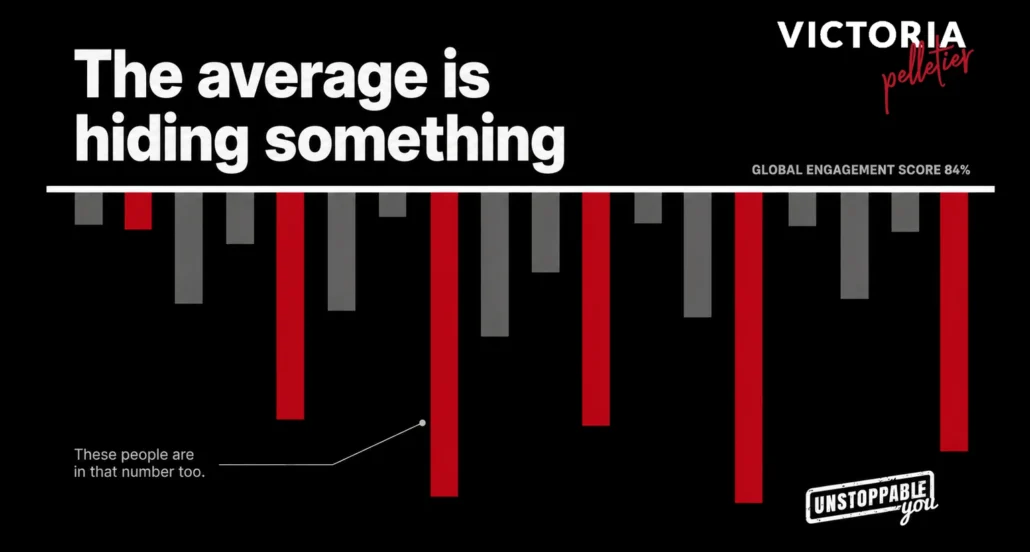
That number is a headcount-weighted average. It describes, with reasonable accuracy, the experience of the majority population. It says almost nothing about the population where the power sits, and nothing whatsoever about the relationship between the two. A leadership team can post a score in the eighties while the specific group of people closest to its decisions is quietly falling apart, and the aggregate will never show it.
This is not a hypothetical failure mode. It is what happens by default, every time, unless somebody insists on seeing the distribution instead of the mean.
Layer the methodology problem on top. Anne-Wil Harzing’s 26-country study found major differences in response styles across countries, driven by cultural variables including power distance, collectivism and uncertainty avoidance. Subsequent multilevel research warns explicitly that these systematic response artifacts get misinterpreted as substantive differences between countries. The literature disagrees about which direction the bias runs in any given place, which is precisely the point. If the researchers who study this for a living cannot agree on the direction, your global average is carrying an error term nobody in your leadership meeting has quantified.
You are averaging across measurement instruments that do not behave identically, and then making promotion and investment decisions off the result.
Here is the part that should sting
The badge does not merely fail to describe the culture. It actively suppresses the impulse to look harder.
I have watched leadership teams treat a certification as a closed file. Compensation questions get deflected because the score was good. Attrition in one region gets waved off because the global number held. A senior leader raises a concern and gets handed a press release as the counterargument. The survey stops being a diagnostic and becomes a defence.
There is a market-research critique making exactly this observation: management ends up delusional, blind to frustration points, reasoning that the company is a Best Place to Work so nothing needs changing. The award becomes the reason to stop asking questions, which is a spectacular inversion of what the survey was supposed to accomplish.
Meanwhile the people who could tell you what is actually happening have already learned that saying so changes nothing.
Where I have to declare my own position
I am approached constantly to be recognized in some list, some magazine feature, some ranking of inspirational leaders. It happens often enough that I have stopped counting.
I have never paid for one. They have always come to me at no cost.
I also know, because I’ve seen the emails, that the same publications quote others thousands of dollars for a comparable placement. Same feature, same layout, same congratulatory language, entirely different price depending on who they think will write the cheque.
I am not going to pretend I find all paid visibility offensive. I coach people on personal branding, and there are legitimate moments to invest in reach, credibility and distribution. That is a market; everyone in it knows it is a market, and the only person whose reputation is at stake is the one paying.
Employee sentiment is a different category altogether. When a company buys a badge that asserts something about how thousands of people experience their working lives, the currency being spent is not the company’s own credibility. It is other people’s lived experience, converted into a recruiting asset, at a price the employees themselves never agreed to.
That is the part I find genuinely difficult to stomach.
What I would do instead
Publish the distribution, not the mean. Break the results by country, by function, by level, by tenure band, and be willing to look at the segment that comes back worst.
Benchmark each population against its own national norm rather than against the global average, so you are comparing like with like instead of comparing measurement artifacts.
Survey more often than annually and stop attaching the results to anybody’s bonus, because the moment a score becomes a target, you have created an incentive to manage the score rather than the culture.
And treat the badge as what it is. A point-in-time perception snapshot from a self-selected participant, purchased for a fee, useful for recruiting and largely useless as evidence that your people are all right.
None of that is complicated. It is just less flattering than a logo.
So the questions I would put to any leader reading this. Do you know what your engagement score looks like for the fifty people closest to your own decisions, separated out from everyone else? Would you publish that number beside the global one? And if the answer to either is no, what exactly do you think the badge on your careers page is proving?
#Leadership #EmployeeEngagement #Unstoppable #NoExcuses