
Your Values Are a Lie. And Your Employees Know It.
There’s a particular kind of corporate theatre that goes something like this: a leadership team spends a small fortune on a two-day offsite, emerges with a beautifully worded set of values — Integrity. Innovation. People First. — prints them on posters, embroiders them in the lobby, and slides them into onboarding decks. Then, six months later, the most toxic senior leader in the building gets promoted because they surpassed their sales target.
And just like that, your culture is defined. Not by what you wrote. By what you did.
The Data Is Damning
This isn’t an anecdote. The numbers are embarrassing for organizations everywhere.
A 2025 Values Gap Report surveyed 1,000 workers and found that while 86% of employees say their company’s values are clearly communicated, only 44% say those values are consistently demonstrated. Just 47% believe their leaders frequently model the company’s stated values — and 70% have witnessed leaders bend rules or play favourites.
Let that land for a second. Nearly nine in ten companies are apparently excellent at communicating their values. Fewer than half are actually living them.
And it gets worse. PwC’s Trust in Business Survey found that 86% of business executives believe their employees highly trust them — while only 67% of employees say they actually do. Leaders are wandering around thinking they’ve built cultures of trust while their people are quietly updating their LinkedIn profiles.
Meanwhile, Gallup reports that only 31% of U.S. employees were engaged in 2024 — the lowest level since 2014 — and disengagement is costing the global economy an estimated $8.9 trillion annually, equivalent to roughly 9% of global GDP.
Nine trillion dollars. Because leaders can’t be bothered to act the way they tell their people to act.
The Formula Nobody Follows
In the gym on Saturday, I listened to an episode of Simon Sinek’s A Bit of Optimism podcast featuring Garry Ridge, the former CEO of WD-40 — a man who spent 25 years building one of the most genuinely admired workplace cultures on the planet. The conversation was a masterclass in the deceptively simple truth about culture.
The essence of what they discussed comes down to this: culture isn’t a statement, it’s an equation. Values plus behaviours, multiplied by consistency.
Values without consistent behaviour are just aspirations. Behaviour without values is just instinct. But values and behaviour, applied consistently — especially by those at the top — that’s where culture actually lives.
I finished the podcast episode wanting to know more about Garry Ridge – and it’s clear that he is not all talk. He has proved it. Under his leadership, WD-40 grew its market cap from $300 million to $3.5 billion, maintained employee engagement above 90%, and built a culture where 98% of employees loved telling others where they worked. That’s not a ping-pong table and free snacks. That’s a leader who understood that the values on the wall have to match the decisions in the room.
Ridge started his career living by the mantra “be brilliant, be brief, be gone” — and had to completely unlearn it. His evolution from transactional manager to culture builder wasn’t a rebrand. It was a reckoning. It took humility, consistency, and the courage to be the same leader in a tough quarter as he was in a good one.
His book, Any Dumb Ass Can Do It, published last year, is worth your time. The title is not false modesty. The point is that this isn’t magic — it’s discipline.
The Real Culture Killer Isn’t Poor Values. It’s the Exceptions.
Here’s what most leaders get wrong: culture doesn’t collapse because your values were poorly chosen. It collapses because you made an exception for the wrong person or people.
According to the same Values Gap research, 24% of employees say toxic top performers are actively protected by leadership. That single data point is a cultural wrecking ball. The moment you shield someone from accountability because they’re “too valuable to lose,” you’ve told every single person in your organization exactly what your values are really worth.
Values without follow-through are worse than useless — they undermine confidence in leadership. Words alone don’t create culture. Values must be shown through consistent, visible behaviour. Silence, avoidance, or selective enforcement erodes credibility.
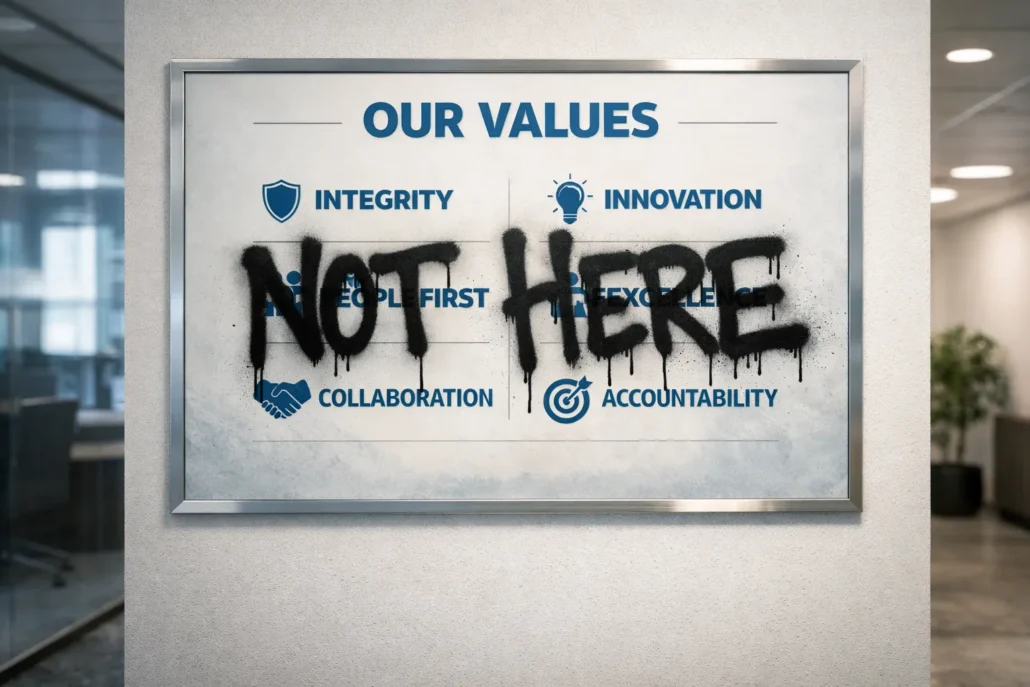
This is also why the poster on the wall can actually do more damage than no poster at all. It’s a daily reminder of the gap between what leadership says and what leadership does.
The Fix Is Not a Workshop
I’ve seen companies respond to culture problems by booking a facilitator and gathering the leadership team for another offsite. Nothing against facilitators (hey, I “AM” one lol) — but culture isn’t a one-time project. It’s a daily practice.
Research consistently shows that employees who trust their managers are five times more likely to be engaged — and that 70% of the variance in team engagement is attributable to the manager. This isn’t an HR problem. It’s a leadership behaviour problem. And no survey, session, or strategy deck fixes behaviour.
What fixes it? Consistency. The same standard applied to the highest performer that’s applied to everyone else. Leaders who are willing to be uncomfortable in service of what they said they believe. Organizations that treat “learning moments” — to borrow Garry Ridge’s framing — as data, not failure.
“People deserve to love their work — even if they don’t like it every single day. People want to feel seen, heard, and valued.” — Simon Sinek
That’s not a line for a vision statement. That’s a daily operating standard.
The Bottom Line
Your employees aren’t reading your values statement. They’re watching you. They’re watching what you reward. What you ignore. Who you protect. How you behave when it costs you something.
Culture is not the thing you declare. It’s the thing you demonstrate — consistently, especially when no one’s looking, and especially when it’s hard.
(Values + Behaviour) × Consistency. Every day. At every level. From the top.
Start there. The posters can wait.
There’s a particular kind of corporate theatre that goes something like this: a leadership team spends a small fortune on a two-day offsite, emerges with a beautifully worded set of values — Integrity. Innovation. People First. — prints them on posters, embroiders them in the lobby, and slides them into onboarding decks. Then, six months later, the most toxic senior leader in the building gets promoted because they surpassed their sales target.
And just like that, your culture is defined. Not by what you wrote. By what you did.
The Data Is Damning
This isn’t an anecdote. The numbers are embarrassing for organizations everywhere.
A 2025 Values Gap Report surveyed 1,000 workers and found that while 86% of employees say their company’s values are clearly communicated, only 44% say those values are consistently demonstrated. Just 47% believe their leaders frequently model the company’s stated values — and 70% have witnessed leaders bend rules or play favourites.
Let that land for a second. Nearly nine in ten companies are apparently excellent at communicating their values. Fewer than half are actually living them.
And it gets worse. PwC’s Trust in Business Survey found that 86% of business executives believe their employees highly trust them — while only 67% of employees say they actually do. Leaders are wandering around thinking they’ve built cultures of trust while their people are quietly updating their LinkedIn profiles.
Meanwhile, Gallup reports that only 31% of U.S. employees were engaged in 2024 — the lowest level since 2014 — and disengagement is costing the global economy an estimated $8.9 trillion annually, equivalent to roughly 9% of global GDP.
Nine trillion dollars. Because leaders can’t be bothered to act the way they tell their people to act.
The Formula Nobody Follows
In the gym on Saturday, I listened to an episode of Simon Sinek’s A Bit of Optimism podcast featuring Garry Ridge, the former CEO of WD-40 — a man who spent 25 years building one of the most genuinely admired workplace cultures on the planet. The conversation was a masterclass in the deceptively simple truth about culture.
The essence of what they discussed comes down to this: culture isn’t a statement, it’s an equation. Values plus behaviours, multiplied by consistency.
Values without consistent behaviour are just aspirations. Behaviour without values is just instinct. But values and behaviour, applied consistently — especially by those at the top — that’s where culture actually lives.
I finished the podcast episode wanting to know more about Garry Ridge – and it’s clear that he is not all talk. He has proved it. Under his leadership, WD-40 grew its market cap from $300 million to $3.5 billion, maintained employee engagement above 90%, and built a culture where 98% of employees loved telling others where they worked. That’s not a ping-pong table and free snacks. That’s a leader who understood that the values on the wall have to match the decisions in the room.
Ridge started his career living by the mantra “be brilliant, be brief, be gone” — and had to completely unlearn it. His evolution from transactional manager to culture builder wasn’t a rebrand. It was a reckoning. It took humility, consistency, and the courage to be the same leader in a tough quarter as he was in a good one.
His book, Any Dumb Ass Can Do It, published last year, is worth your time. The title is not false modesty. The point is that this isn’t magic — it’s discipline.
The Real Culture Killer Isn’t Poor Values. It’s the Exceptions.
Here’s what most leaders get wrong: culture doesn’t collapse because your values were poorly chosen. It collapses because you made an exception for the wrong person or people.
According to the same Values Gap research, 24% of employees say toxic top performers are actively protected by leadership. That single data point is a cultural wrecking ball. The moment you shield someone from accountability because they’re “too valuable to lose,” you’ve told every single person in your organization exactly what your values are really worth.
Values without follow-through are worse than useless — they undermine confidence in leadership. Words alone don’t create culture. Values must be shown through consistent, visible behaviour. Silence, avoidance, or selective enforcement erodes credibility.
This is also why the poster on the wall can actually do more damage than no poster at all. It’s a daily reminder of the gap between what leadership says and what leadership does.
The Fix Is Not a Workshop
I’ve seen companies respond to culture problems by booking a facilitator and gathering the leadership team for another offsite. Nothing against facilitators (hey, I “AM” one lol) — but culture isn’t a one-time project. It’s a daily practice.
Research consistently shows that employees who trust their managers are five times more likely to be engaged — and that 70% of the variance in team engagement is attributable to the manager. This isn’t an HR problem. It’s a leadership behaviour problem. And no survey, session, or strategy deck fixes behaviour.
What fixes it? Consistency. The same standard applied to the highest performer that’s applied to everyone else. Leaders who are willing to be uncomfortable in service of what they said they believe. Organizations that treat “learning moments” — to borrow Garry Ridge’s framing — as data, not failure.
“People deserve to love their work — even if they don’t like it every single day. People want to feel seen, heard, and valued.” — Simon Sinek
That’s not a line for a vision statement. That’s a daily operating standard.
The Bottom Line
Your employees aren’t reading your values statement. They’re watching you. They’re watching what you reward. What you ignore. Who you protect. How you behave when it costs you something.
Culture is not the thing you declare. It’s the thing you demonstrate — consistently, especially when no one’s looking, and especially when it’s hard.
(Values + Behaviour) × Consistency. Every day. At every level. From the top.
Start there. The posters can wait.