The Whole Human Capitalist Plays the Long Game
I’m a capitalist. Unapologetically.
I like profit. I like growth. I have never once apologized for a healthy margin, and I don’t plan to start.
I also believe most companies leave serious money on the table by treating their people as a line item to be trimmed and their customers as a number to be harvested. So I’ve started calling myself a Whole Human Capitalist: someone who wants the profit and plays the long game to get it. I’ve been asked more than once what on earth that means.
Let me explain.
The math nobody wants to do
Alex Edmans, a finance professor at London Business School, spent years testing a blunt question. Do companies that treat their employees well make better investments, or do they just burn cash keeping people happy?
He built a portfolio from the publicly traded companies on the “100 Best Companies to Work For in America” list and tracked it from 1984 to 2009. After controlling for the usual factors that drive stock returns, it outperformed by about 3.5% a year, and beat industry benchmarks by about 2.1%. In his book Grow the Pie, he sums up the long-run edge as 2.3% to 3.8% a year, which compounds to 89% to 184% cumulatively.
He repeated the exercise in the UK. A portfolio of the UK’s Best Workplaces held from 2001 to 2023 delivered more than four times the return of the FTSE All-Share.
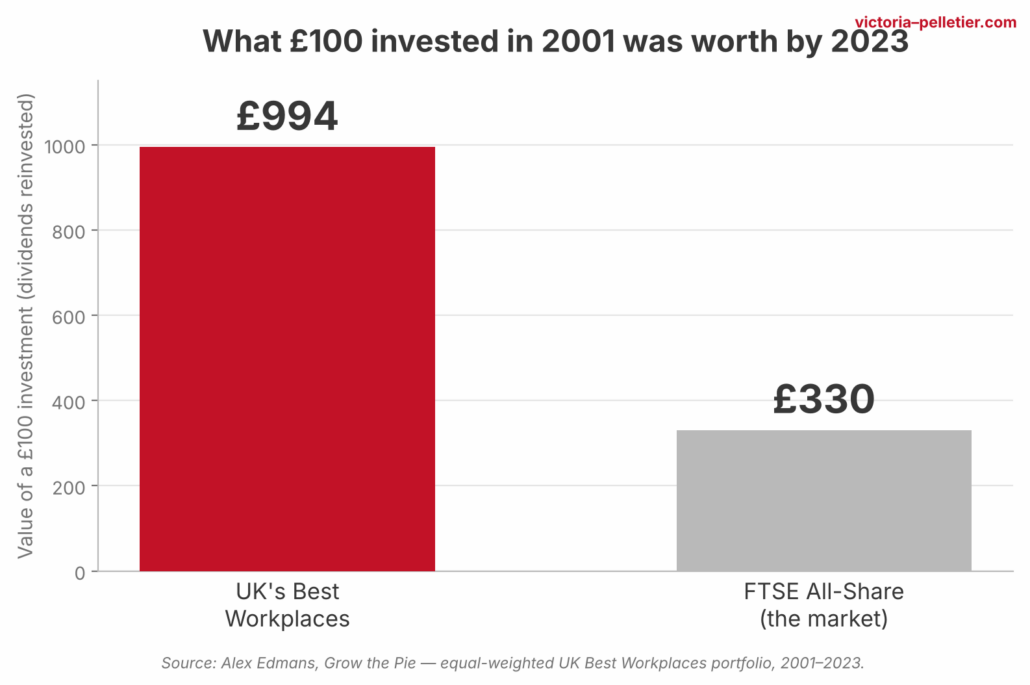
The same £100, invested in 2001, in two different kinds of company.
None of this came out of a wellness retreat. It came from a finance professor running regressions on stock returns, which is about as unsentimental as research gets.
Here’s the part that should sting
If treating people well pays, why don’t more companies do it?
Edmans offers two uncomfortable answers. First, investors still value companies with tools designed for the era of factories and physical assets, and those tools are terrible at seeing culture, trust or loyalty. Second, there’s managerial myopia. When you invest in your people, the only thing that shows up right away is lower earnings. The payoff arrives later, often after the executive who made the call has collected the bonus and moved on.
So the quarter gets the applause, and the company gets the bill.
I’ve walked into enough turnarounds to recognize the invoice when it shows up. The cuts that looked brilliant in Q3 come back as attrition, rehiring costs, lost institutional knowledge and customers who quietly stopped returning calls. Nobody books those against the original decision. Somebody should.
My love/hate relationship with the quarterly call
I’ve spent most of my career inside publicly traded companies, and I’ll be honest: I have a genuine love/hate relationship with them.
I love the discipline. Public markets demand clarity, accountability and a scoreboard everyone can read. I’ve never been afraid of a number, and some of my best work has come from being held to one.
What I struggle with is the pattern. Making a trade-off for a quarterly result now and then is part of running a business, and any leader who claims otherwise hasn’t run one. Making that same trade-off time and time again, with clients and employees picking up the bill every single time, is something else entirely. I’ve watched client relationships that took a decade to build get spent in a single quarter. I’ve watched good people absorb cuts made to hit a number, with no plan for what came after.
Over the years, I’ve tried to change that from the inside more than once. I’ve pushed back in the room, made the case with the numbers, and asked the uncomfortable question when everyone else was nodding.
And more than once, I’ve walked away. When the values on the wall stopped matching what leadership actually rewarded, leaving was the most honest decision I could make. It’s never the easy call, and it’s never free. I’d make it again every time.
What frustrates me most is that it never had to be a choice.
Throughout my career, I’ve led teams to top employee engagement scores, earned strong client satisfaction and delivered strong business results, often in the same year and with the same people. In my experience, the first two are how you get the third. Engaged people serve clients better, loyal clients stay and buy more, and the P&L notices.
The relationships are the business
I’ve had Adam Grant in my ears on audiobook lately, and his research on givers and takers keeps rhyming with something I’ve believed my whole career. Takers win the quarter. Over a long enough horizon, it’s the givers — the people who lead with generosity — who come out ahead.
That’s how I’ve always sold, and it’s how I coach others to sell: from generosity, not greed. Show up to be useful. Give before you ask for anything back. And never forget that the person across the table has a career, a family and a reputation of their own riding on whether they can trust you. The leader who treats every interaction as a transaction to be won gets one quarter of value out of it. The one who builds a real relationship gets a client who calls first, forgives the occasional miss, and sends other people their way. None of that is soft. It’s the highest-margin growth there is, and it never shows up on the slide that gets the applause.
The same holds inside the building. People give their best work to leaders they trust, not to the ones who squeeze the most out of them. Loyalty never appears as a line item, but it makes every other line item cheaper.
What a Whole Human Capitalist actually does
I still want the margin. I just insist on measuring what it really cost to get there. That means treating training, fair pay and good managers as investments, and holding them to a return like any other line in the budget. Customer trust belongs on the books as an asset too — anyone who has tried to win back a burned client knows exactly what rebuilding it costs. And the returns shareholders take out should come from a business that will still be standing in ten years, staffed by people who chose to stay.
That’s what playing the long game means to me: fiscal discipline with a longer time horizon. Cutting people to make a quarter is easy; any spreadsheet can do it before lunch. Building a company where good people stay and customers keep coming back takes judgment, patience and a leader willing to defend an investment that won’t pay off by the next earnings call.
So, what kind of capitalist are you?
Pull up the last three cost decisions your leadership team made. How many would survive a five-year view? If your three best people resigned on Monday, could anyone in the room put a dollar figure on what just walked out the door? And when was the last time someone on your team defended an investment in people with the same rigour they’d use for a new data centre?
I’m a Whole Human Capitalist. And I play the long game.
#Unstoppable #NoExcuses #WholeHumanLeadership #TurnaroundQueen #Leadership
— For the first comment (links) —
Edmans, “Does the Stock Market Fully Value Intangibles? Employee Satisfaction and Equity Prices” (paper).
Summary of the 1984–2009 findings (3.5% annual alpha, 2.1% over industry benchmarks): Hedge Fund Alpha.
Edmans’s UK Best Workplaces study, 2001–2023 (more than 4x the FTSE All-Share): Enterprise Engagement.
Why investment in people is under-priced (myopia, intangibles): Pacific Standard.
Adam Grant, Give and Take — the research on givers, takers and who wins the long game.
More on building the authority to win these arguments in the room: my new book, Influence Activated, out November.